
The probability of a harmful effect from radiation exposure depends on which part or parts of the body are exposed.
Units
Slovenia uses the International System of Units (SI). The USA uses a different system, which can lead to confusion. The following explanation focuses on SI units.
We identify two general phenomena when discussing radiation. We measure “activity” and “exposure”. Activity is basically just how much radiation is coming out of something, whether it’s particles or waves. Exposure measures the effect of radiation on substances that absorb it.
Radiation Activity
Radiation activity is measured in the international (SI) unit, the becquerel (Bq). The becquerel measures the number of particles or photons (in the case of wave radiation) emitted per second by a source. The device used for measurement is often the familiar Geiger counter. If you put a Geiger counter over a gram of substance and count 3 clicks per second, the radioactivity of that substance would be 3 becquerel.
Radiation Exposure
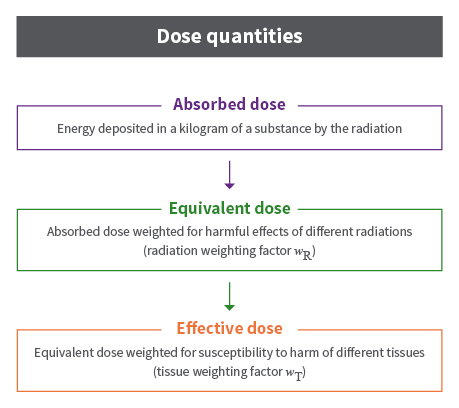
Radiation exposure is expressed in several ways to account for the different levels of harm caused by different forms of radiation and the different sensitivity of body tissues.
Absorbed Dose
Radiation exposure is measured in the international (SI) unit, the grey (Gy). The radiation exposure is equivalent to the energy “deposited” in a kilogram of a substance by the radiation. Exposure is also referred to as absorbed dose. The important concept is that exposure is measured by what radiation does to substances, not anything particular about the radiation itself. This allows us to unify the measurement of different types of radiation (i.e., particles and waves) by measuring their effects on materials.
The gray is a large unit and for normal radiation protection levels, a series of prefixes are used:
- nanogray (nGy) is one thousand millionth of a gray (1/1,000,000,000)
- microgray (µGy) is one millionth of a gray (1/1,000,000)
- milligray (mGy) is one thousandth of a gray (1/1,000)
Equivalent Dose
Often, we are interested in the effect of radiation exposure on human tissue. Enter a quantity called equivalent dose. This relates the absorbed dose in human tissue to the biological damage caused by radiation. Not all radiation has the same biological effect, even at the same absorbed dose. The equivalent dose is measured in the international (SI) unit, the sievert (Sv). Like the grey, the sievert is a large unit, and for normal radiation protection levels ,a series of prefixes is used:
- nanosievert (nSv) is one thousand millionth of a sievert (1/1,000,000,000)
- microsievert (µSv) is one millionth of a sievert (1/1,000,000)
- millisievert (mSv) is one thousandth of a sievert (1/1,000)
To determine equivalent dose (Sv), you multiply absorbed dose (Gy) by a radiation weighting factor that is unique to the type of radiation. The radiation weighting factor (WR) takes into account that some kinds of radiation are inherently more dangerous to biological tissue, even if their “energy deposition” levels are the same.
For x-rays, gamma rays, and electrons absorbed by human tissue, WR is 1. For alpha particles, it is 20. To compute sieverts from greys, simply multiply by WR. This is obviously a simplification. The radiation weighting factor WR approximates what otherwise would be very complicated computations. The values for WR change periodically as new research refines the approximations.
Effective Dose
The probability of a harmful effect from radiation exposure depends on which part or parts of the body are exposed. Some organs are more sensitive to radiation than others. A tissue weighting factor (WT) is used to account for this. When an equivalent dose to an organ is multiplied by the tissue weighting factor for that organ, the result is the effective dose to that organ. The unit of effective dose is the sievert (Sv).
If more than one organ is exposed, then the effective dose, E, is the sum of the effective doses to all exposed organs.
| Tissue | Tissue weighting factor WT | Sum of Tissue weighting factors |
|---|---|---|
| Bone-marrow (red), colon, lung, stomach, breast, remaining tissues(*) | 0.12 | 0.72 |
| Gonads | 0.08 | 0.08 |
| Bladder, oesophagus, liver, thyroid | 0.04 | 0.16 |
| Bone surface, brain, salivary glands, skin | 0.01 | 0.04 |
| Total | 1.00 |
(*) Remaining tissues: Adrenals, extrathoracic region, gall bladder, heart, kidneys, lymphatic nodes, muscle, oral mucosa, pancreas, prostate, small intestine, spleen, thymus, uterus/cervix